| Panel |
|---|
| borderColor | #e0e0e0 |
|---|
| bgColor | #f0f0f0 |
|---|
| Create a surface shader.

- In the Nodegraph, press
S to display the shading node layered menu. Begin to type "material". - Pick material3Delight to create the shading node. A NetworkMaterial node is automatically created and connected to the output of the new material3Delight node.
|
| Panel |
|---|
| borderColor | #e0e0e0 |
|---|
| bgColor | #f0f0f0 |
|---|
| Create a texture for the surface shader.

- In the Nodegraph, press
S to display the shading node layered menu. Begin to type "checker". - Pick checker to create the node. Since checker is a 2D Texture node, a place2dTexture node is automatically created and connected to it.
- Click on the faint square to the right of the node name label (or press E) to edit the node's parameters in the Parameters panel.
|
| Panel |
|---|
| borderColor | #e0e0e0 |
|---|
| bgColor | #f0f0f0 |
|---|
| Configure the place2dTexture shader.

- Set the RepeatU and RepeatV parameters to 8.
|
| Panel |
|---|
| borderColor | #e0e0e0 |
|---|
| bgColor | #f0f0f0 |
|---|
| Connect the texture shader to the surface shader.
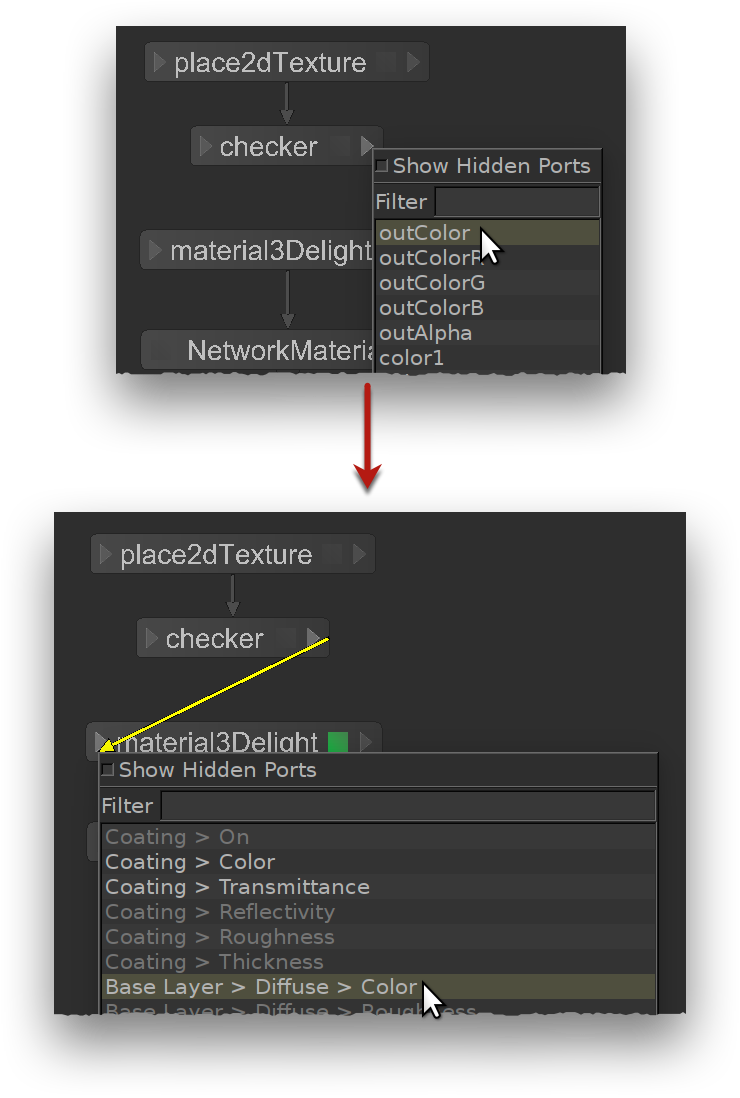
- Click on the arrow to the right of the checker node to select an output port to connect.
- Select outColor from the output port list.
- Click the arrow to the left of the material3delight node to select the input port to connect.
- Select Base Layer → Diffuse → Color.
|
The NetworkMaterial can be assigned using a materialAssign Katana node. |